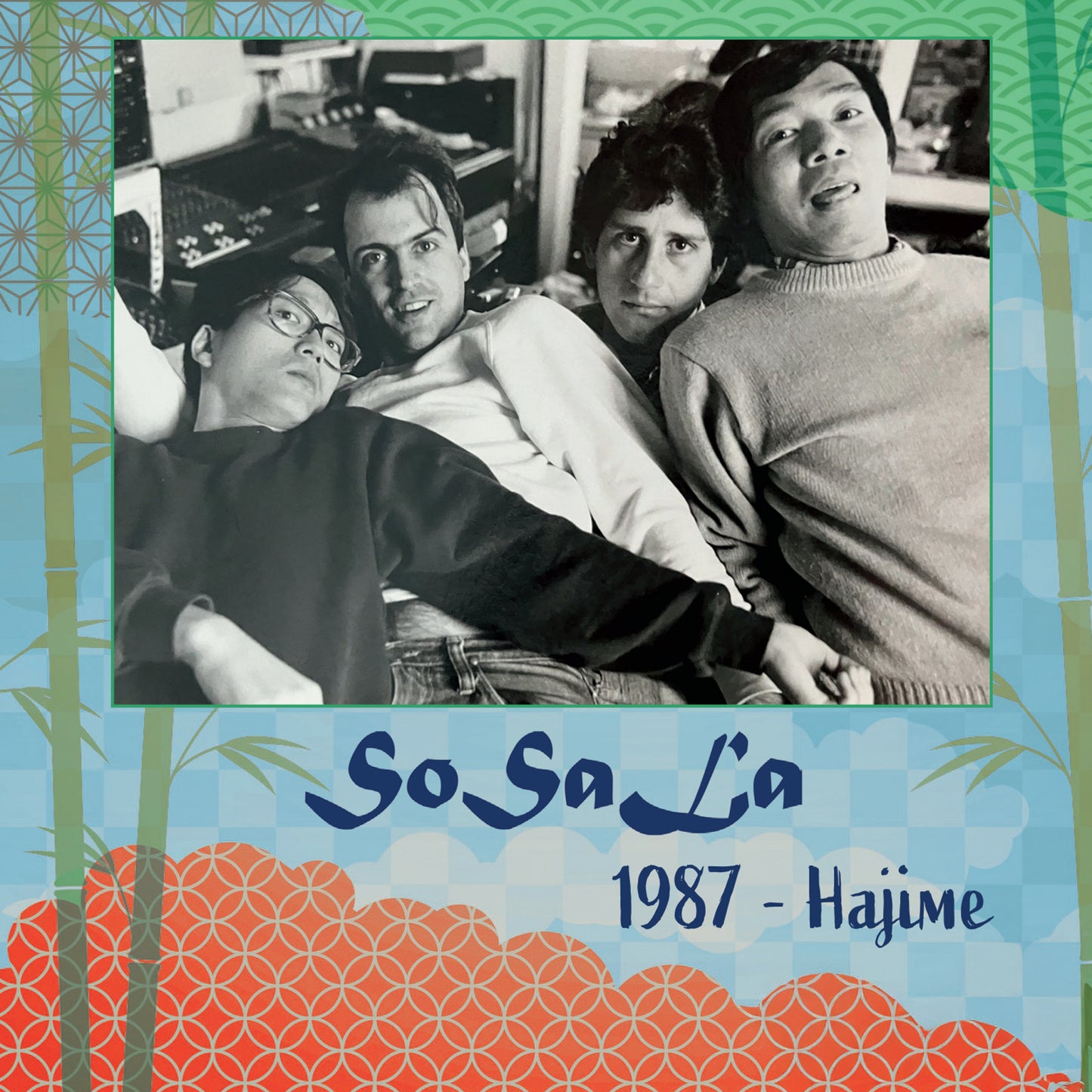

SoSaLa - 1987 - Hajime (CD)
SoSaLa - 1987 - Hajime (CD)
Couldn't load pickup availability
SoSaLa has released another retrospective CD. This time, re-releasing the 1987 LP ALEF "Hajime", originally released on SoSaLa's Japanese independent label, Kampai Records. "Alef" is the first letter of the Iranian alphabet, marking the beginning of SoSaLa's music career with that LP release, which is still available on SoSaLa's website—sold at a premium price.
This retrospective album is another must for fans interested in SoSaLa's accomplished music career. The music on this album comes from the Japanese free jazz-punk-noise scene of the 80s. No band in Japan sounded like ALEF, a short-lived but pioneering multimedia performance group active in the mid-1980s.
The music was a Dadaistic blend of jazz-core, progressive rock, and avant-garde, often described as "rock-jazz-industrial" with heavy improvisation. The contributions of all musicians on this album add unique dimensions and startling voices, enhancing an already compelling and potent mix.
The music sits well with rock and jazz, yet transcends both genres.
ALEF (1985-1987) (Hi)Story
In 1984, when SoSaLa lived in Osaka and was known as Sadato, he decided to disband his Osaka band, SADATO GROUP, even though it had established itself as a powerful group. He felt musically stuck in Osaka and needed another "kick" to grow in the Japanese music scene and in his career. He moved to Tokyo, Japan's entertainment and music center. With its many record companies and publishers, Tokyo was the best place for a professional musician and band leader to grow.
When SADATO GROUP played in Tokyo, Sadato invited local musicians to perform with him, such as Tom Hojnacki from the US on drums and percussion, Douglas Lamont from Canada on keys and vocals, a striptease dancer, and Butoh dancers from the Butoh dance group Hoppoh Butoh Ha. He contacted all of them and invited them to rehearsals to form a new band. He also looked for new members—this time, jazz musicians who could also play rock.
At a Karl Berger Orchestra gig in 1984, he became friendly with the jazz bassist Yo Nakamura. They decided to jam, and Nakamura invited the jazz drummer Tatsuya Ishida to join them. Together, they had such a good time playing that Sadato decided to form a band with them, ALEF. Later joined by Tom Hojnacki (percussion), Douglas Lamont (keys), and Dennis Gunn (guitar), whom he met at an ESL school in Tokyo.
Unfortunately, Nakamura left the band for personal reasons and moved to the countryside to live with his family. Gunn joined the band, bringing in a young jazz-rock musician on acoustic and electric fretless bass, Hideki Kato. This was the birth of ALEF, consisting of a jazz drummer, a kind of Adrian Belew guitarist, and a Jack Bruce bassist.
The lineup and instrumentation were: Sadato (saxophones, synthesizer, flute, and vocals), Dennis Gunn (guitars and vocals), Hideki Kato (electric and acoustic bass and vocals), and Tatsuya Ishida (drums and vocals). With special guests Toshiko on synthesizer and Romi on voice.
The photographer, Ryutaro Hidaka, was a friend of Kato's who later fell in love with ALEF. He became the band's regular photographer.
After a couple of well-received gigs, Sadato felt they had enough material to record an album. Gunn found a studio on the outskirts of Tokyo. The studio owner, H. Nagasawa, who attended one of ALEF's concerts, invited them to record at his White House Studio. He and his assistant, T. Inagaki, were behind the recording board.
Unfortunately, after the LP was released, Ishida and Gunn decided to leave the band. A couple of months later, he formed his next band, SADATO, with Kato.
About the Musicians
SoSaLa (who called himself Sadato in Japan) – whom the legendary jazzman Ornette Coleman, one of SoSaLa's mentors, described later as "the freest rock saxophonist" is a saxophonist/band leader/composer/improviser and who has lived and performed in Switzerland (1953), Germany (1953 - 1974), Japan (1974 - 2008), and the US (2008 - present). During his Japan residency, he had performed and/or recorded as a leader with his bands (Sadato-Ino Group, SADATO GROUP, ALEF, SADATO, The Tehran-Dakar Brothers, a.o.) and with Karl Berger, Toshinori Kondo, Motoharu Yoshizawa, Hideo Yamaki, Mototeru Takagi, Eugene Chadbourne, Peter Gordon, Vinny Golia, The Blech, TWILIGHT CIRCUS, with the Butoh group Dai Rakuda Kan, Salif Keita, Wagane N'Diya Rose, Fanfare Ciocarlia, Warsaw Village, a.o. He toured with his respective bands in Japan, Europe, the US, Hong Kong, and Mali. He released many CDs on his own label. Some of them were released in Europe and played at prestigious clubs and festivals in Japan and around the world. Wherever he went, interviews were done and published in Japanese, German, French, and Spanish. He also released a couple of short film videos documenting his life and music in Tokyo, directed by indie filmmaker Steve Black.
Sadato was renowned in Japan for his saxophone and stage performances. He became a notable figure in the Japanese free jazz and indie rock scenes due to his multimedia (music, video, and stage performance) and multilingual (English, German, Japanese, and Farsi) performances. SADATO GROUP was the only band blending elements of (free) jazz, rock, and Middle Eastern 6/8 and modes into its performances.
As an instrumentalist and composer, he was musically influenced by Japanese free jazz musicians such as Yamashita Yosuke and improvisers such as Toshinori Kondo. As a singer, he draws inspiration from vocalists such as Jim Morrison, Captain Beefheart, and Johnny Rotten, as well as from flamenco and Persian classical singers. And as a stage performer, he incorporated Butoh dance, mime, and martial arts movements.
Sadato's unique background—Iranian, living in Japan, and practicing martial arts—allowed him to bring a distinct cultural and musical fusion to his work, resonating across genres and audiences.
His tenor and soprano saxophone playing was unique and original. He didn't care for technique so much as the sound of the sax. He was self-taught and never studied music. He left the "talking" primarily to his sax and the other instruments he played: guitar, drums, harmonica, flute, synthesizer, and the flute. His work often features an expressive, fluid style that enhances the music's overall atmosphere, whether in live performances or recordings.
His music may appeal to listeners who enjoy experimental jazz or cross-cultural collaborations. Through performance and music, Sadato was a great communicator with the audience. Sometimes, he would invite an audience member to join the band.
In addition to his unique work as a musician, Sohrab was also the president of the music record company, POP BIZ Rec, and CD import distributor POP BIZ Ltd (1993-2008). From 2004 to 2007, he was also the chief editor of the Tokyo cross-cultural music magazine Doo Bee Doo Bee Doo, published by POP BIZ Ltd. In 2005, Sadato organized the international world music festival DOO BEE FES in collaboration with SMASH CORPORATION in the old city of Tokyo.
He was also known in Japan as an incisive interviewer, in particular for a series of interviews he conducted for Jazz Critics (one of the top Japanese JAZZ journals), with Horace Silver, Don Cherry, Michel Petrucciani, Larry Ochs of the Rova Saxophone Quartet, Elliott Sharp, Lynn Johnston, Vinnie Golia, Peter Gordon, THE BLECH, engineer/producer Martin Bisi, Akita Masami, and Scott Baker, editor of Option (US music magazine).
Tatsuya Ishida
In 1971, he formed the Ishida Tatsuya Quintet. Performing at the legendary jazz club, the Pit Inn. In 1980, he performed with American banjoist, guitarist, and music critic Eugene Chadbourne. Joined ALEF in 1986.
Hideki Kato
After leaving ALEF, he founded his first band, PIANO PLAYER, in 1987. Several distinct phases and innovative projects characterize his post-ALEF work: Ground Zero (1990–1992): He was a founding member of this seminal Tokyo noise unit led by Otomo Yoshihide. Death Ambient (1995–Present): Formed in New York with Fred Frith and Ikue Mori, this trio released three albums on John Zorn's Tzadik Records, including Death Ambient (1995), Synaesthesia (1999), and Drunken Forest (2007). Green Zone (2004–2008): Kato led this trio featuring the original Ground Zero lineup. They released two albums, Green Zone (2005) and Bayt (2008), inspired by the US invasion of Iraq. OMNI (2009): A collaborative project with Toshimaru Nakamura and Tetsuzi Akiyama. Plastic Spoon: His more recent rock-and-roll project for which he plays bass and writes both music and lyrics, featuring Karen Mantler and Shahzad Ismaily.
Dennis Gunn
Dennis Gunn, also known as Dionisius and T.I.M., is an American producer/songwriter/vocalist/ voice, and TV actor. He is an American musician and actor from Washington. Since 1985, he has lived in Tokyo. After leaving ALEF, he served as the guitarist for the influential new wave band Yapoos, fronted by the legendary actress Jun Togawa.
In 1993, he formed his own rock band, Mighty John Henry, in Tokyo, where he serves as the primary songwriter, lead vocalist, and guitarist. Meanwhile, Dennis has also appeared in television commercials and in NHK's drama Ryomaden (龍馬伝).
Fans of rhythm games may recognize his guitar and vocal work from the GuitarFreaks and DrumMania series, including tracks like "KING G" and "Tail Spin" (on BEMANI / Konami)
Toshiko
When Gunn was the guitarist for a Tokyo indie rock band, Toshiko was the keyboard and synthesizer player. Dennis introduced Toshiko to Sadato, who later invited her to play on track #7.
Romi
Romi was a makeup artist who spoke the Kyoto dialect on track #9.
Share